
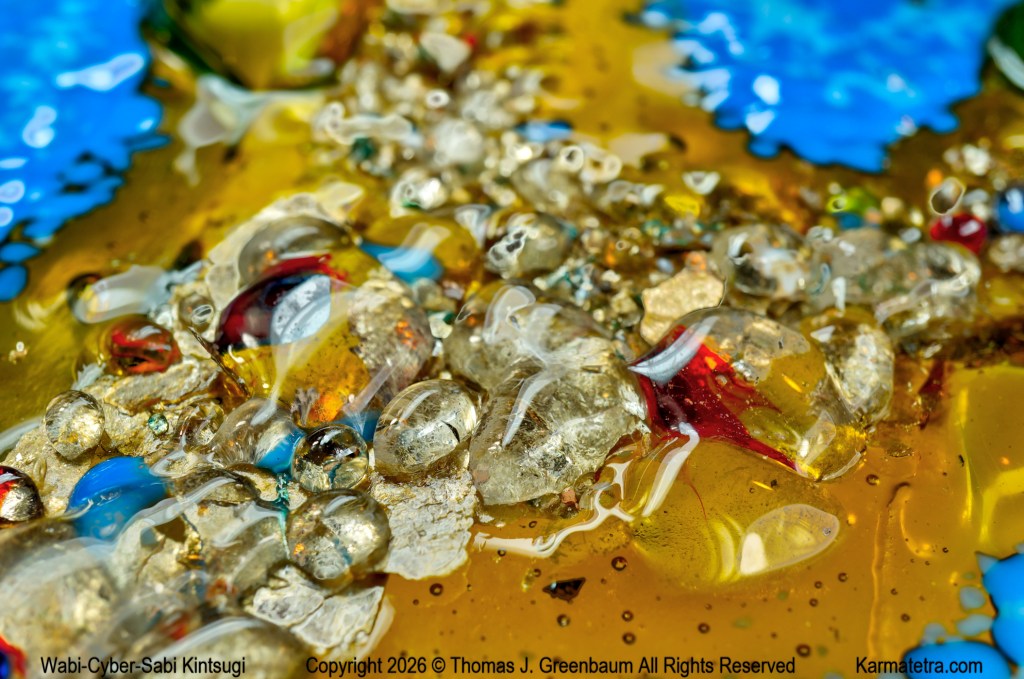
A companion text for Wabi‑Cyber‑Sabi Kintsugi
A Field Note from Ojo Caliente, NM
The muscovite in my Wabi-Cyber-Sabi Kintsugi artwork was gathered from an abandoned mica mine in Ojo Caliente, New Mexico, where desert wind moves through collapsed beams and the ground still glints with the memory of ancient light. This landscape — a meeting point of erosion, silence, and slow geological dreaming — is the mineral’s first studio.
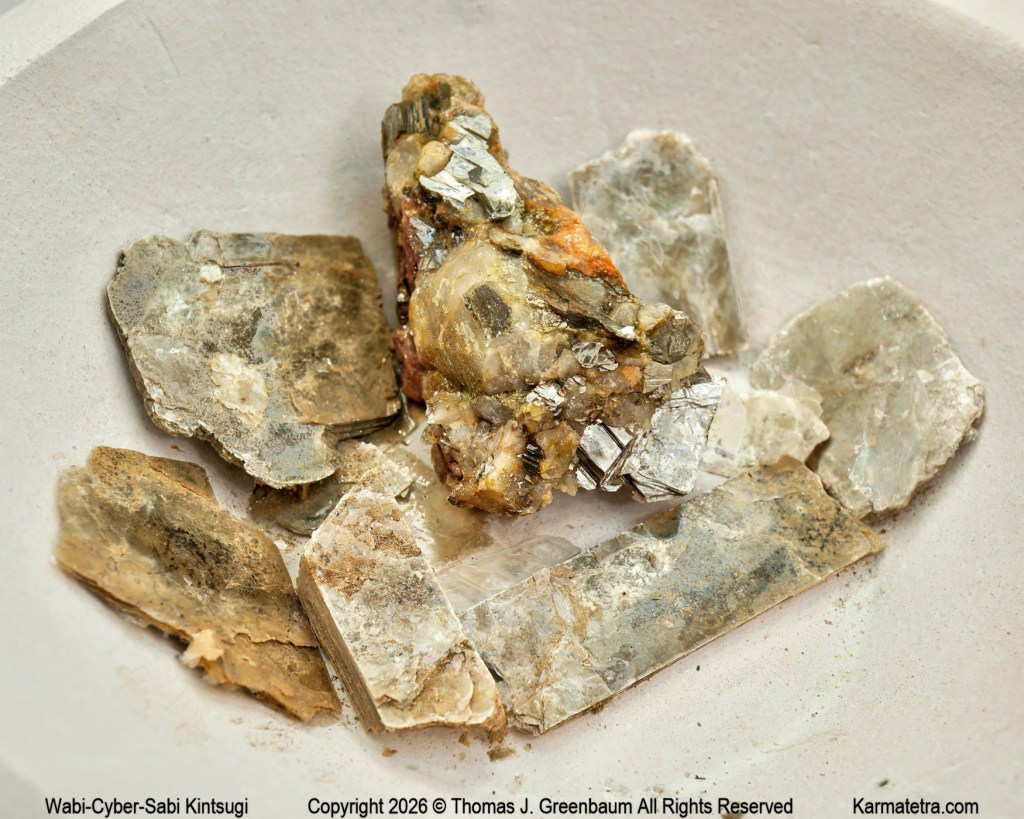
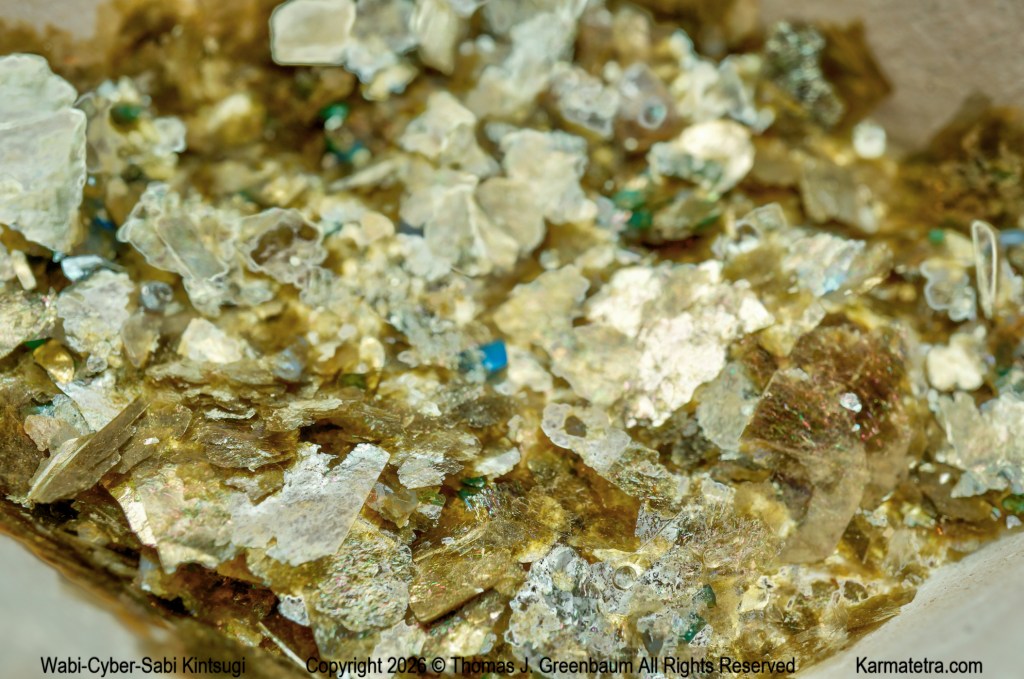
The photo on the left is mica in the raw, as gathered from the site. The photo on the right are small flakes of that same mica after being in the kiln at full-fuse temperatures typically 1460°F–1490°F (793°C–810°C).
Material Nature
Muscovite is a layered silicate, a mineral built like a book of time. Each sheet holds:
- traces of primordial water
- pockets of ancient air
- the pressure‑script of metamorphic transformation
To hold a flake is to hold a thin, shimmering archive of the earth’s long breath.
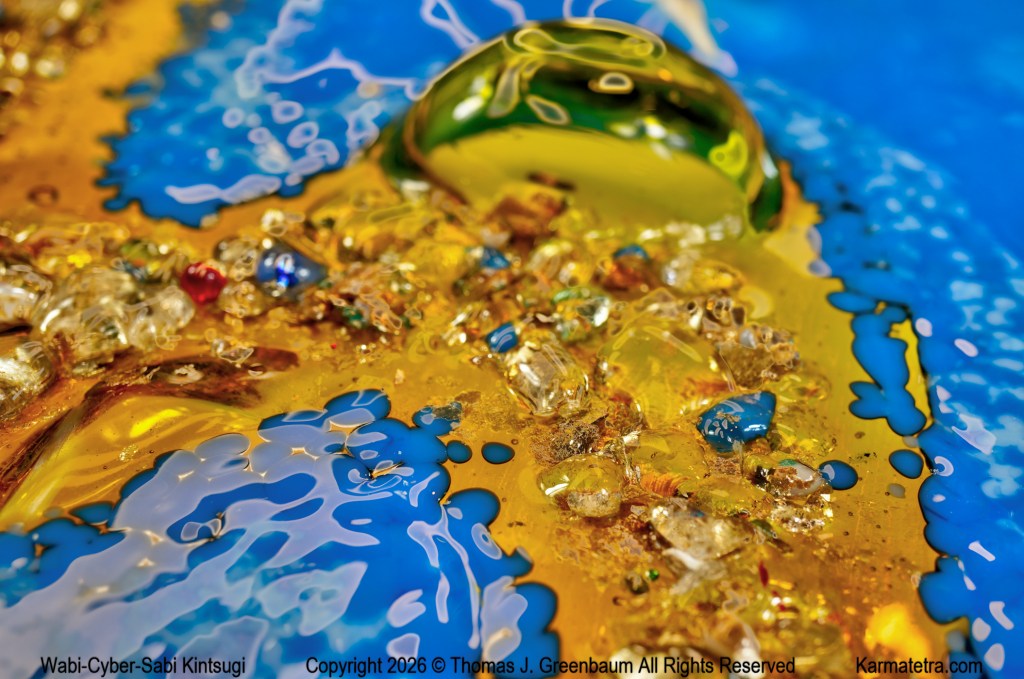
The following are close-up photos of my Wabi-Cyber-Sabi Kintsugi artwork.
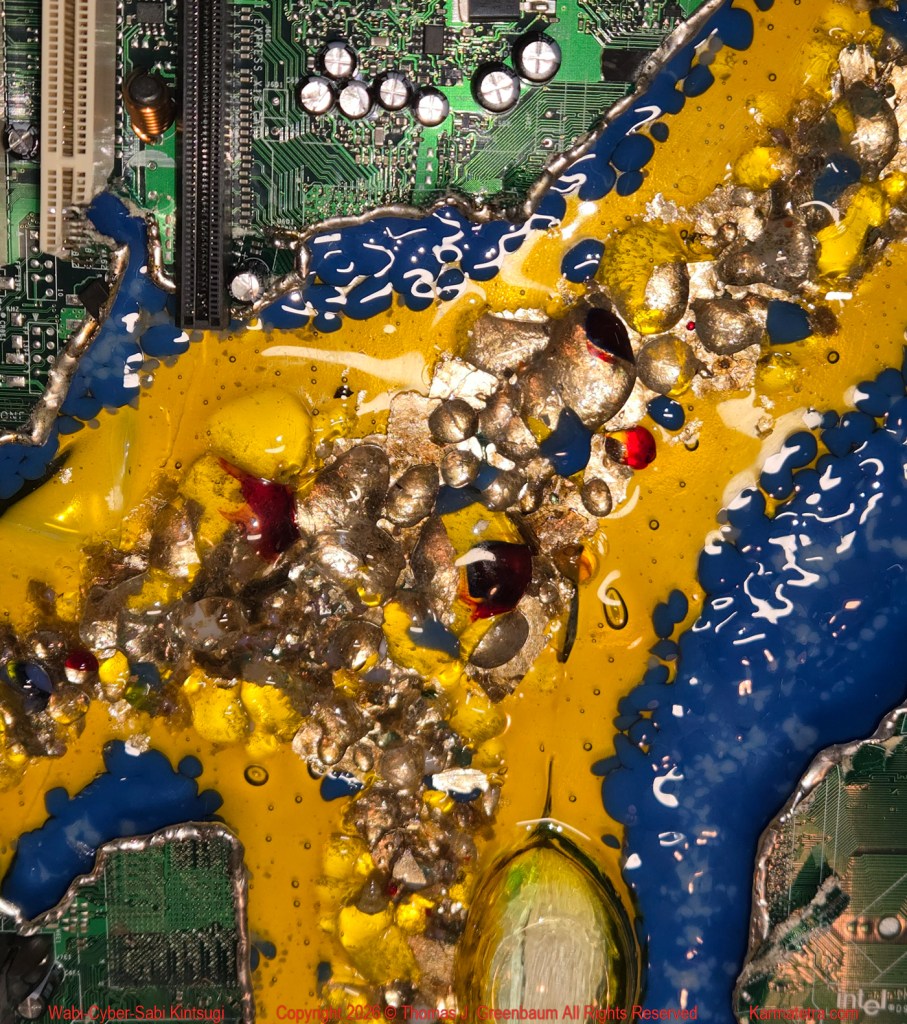
Transformation in the Kiln
When fused into glass, the muscovite undergoes a brief but profound metamorphosis:
- It exhales the volatiles trapped between its layers.
- The glass swells into bubbles, each one a tiny reliquary of geological memory.
- The mineral shifts from soft gray to radiant gold, as if remembering the sun that once warmed the early earth.
These changes are not accidents of heat — they are revelations.
Symbolic Role in my Artwork
In my Wabi-Cyber-Sabi Kintsugi artwork, the Ojo Caliente muscovite becomes a messenger between eras. Its transformation embodies a central truth of my practice:
Repair is not the restoration of what was broken, but the unveiling of what has always been waiting beneath the fracture.
The bubbles become breath marks.
The gold becomes testimony.
The mineral becomes a bridge between the cybernetic and the ancient, the digital shimmer and the geological whisper.
Mythic Reflection
Here, muscovite is not merely a material.
It is a collaborator.
A witness.
A slow intelligence rising into light.
Its presence in my Wabi-Cyber-Sabi Kintsugi artwork reminds us that every act of making is also an act of listening — to the earth, to time, to the quiet persistence of matter that has survived pressures we can barely imagine.
A desert memory carried into glass, a geological breath rising into light.
Technical Notes
What Muscovite Mica Is
Muscovite is the most common form of mica, a potassium aluminum silicate:

It’s the classic silvery‑gray, translucent sheet mica — the kind that peels into thin, flexible layers. If you’ve ever seen old stove windows, early electrical insulators, or vintage capacitors, that’s muscovite.
Why Muscovite Turns Gold in the Kiln
The golden transformation is characteristic of muscovite under heat. Here’s why:
1. Iron impurities oxidize
Even “clean” muscovite contains trace iron. When heated, those ions can shift oxidation states, producing:
- gold
- bronze
- coppery tones
- sometimes even rainbow iridescence
This is especially pronounced when the mica is partially encapsulated in molten glass.
2. Dehydration changes optical properties
Muscovite contains structural hydroxyl groups. When heated, it loses some of that bound water, altering how light refracts through the layers — often enhancing warm metallic tones.
3. Surface reduction/oxidation from the kiln atmosphere
Depending on the kiln schedule and oxygen availability, the mica can develop a thin metallic sheen.
The brilliant gold evident in my Wabi-Cyber-Sabi Kintsugi artwork is muscovite doing exactly what muscovite does when it’s pushed into the alchemical realm.
Why Muscovite Causes Bubbles
Muscovite is a layered silicate with:
- trapped water
- trapped air
- micro‑inclusions
- interlayer volatiles
When heated, it releases these — out‑gassing — which forms bubbles if the mica is sandwiched between glass layers. This is normal and not hazardous in the tiny quantities involved in kiln work.
Closing Poetic Note
I close this page with a poetic note, because the inclusion of muscovite in my artwork takes place in mythic space.
Muscovite is literally a memory mineral — a layered archive of geological time. When it is fused into glass, this is not just embedding a mineral; it is releasing:
- ancient water
- ancient air
- ancient trapped light
It’s a perfect material for the Kintsugi (gold repair) depicted by my Wabi-Cyber-Sabi Kintsugi artwork, where the past and future speak through fracture, repair, and illumination.
 Karmatetra