AI Pages:
- AI Roosters
- Alien Orbs Meet Military Technology
- Alien UAP Orbs Kugelblitz Nodes
- First Contact Is Not With Humans
- Midjourney AI Prompt Examples
- Robot Painters
Exploring the Role of AI in Art and the Broader World
Generative artificial intelligence represents a fundamental shift in how creative concepts are conceived, rendered, and distributed. Rather than simply serving as an automated tool, AI functions as a creative partner that blurs the boundaries between human intent and machine synthesis. This evolving dynamic opens new possibilities for artistic expression while simultaneously challenging traditional concepts of authorship, aesthetics, and creative economics.
Visualizing Collaboration: Human and Machine Synergy
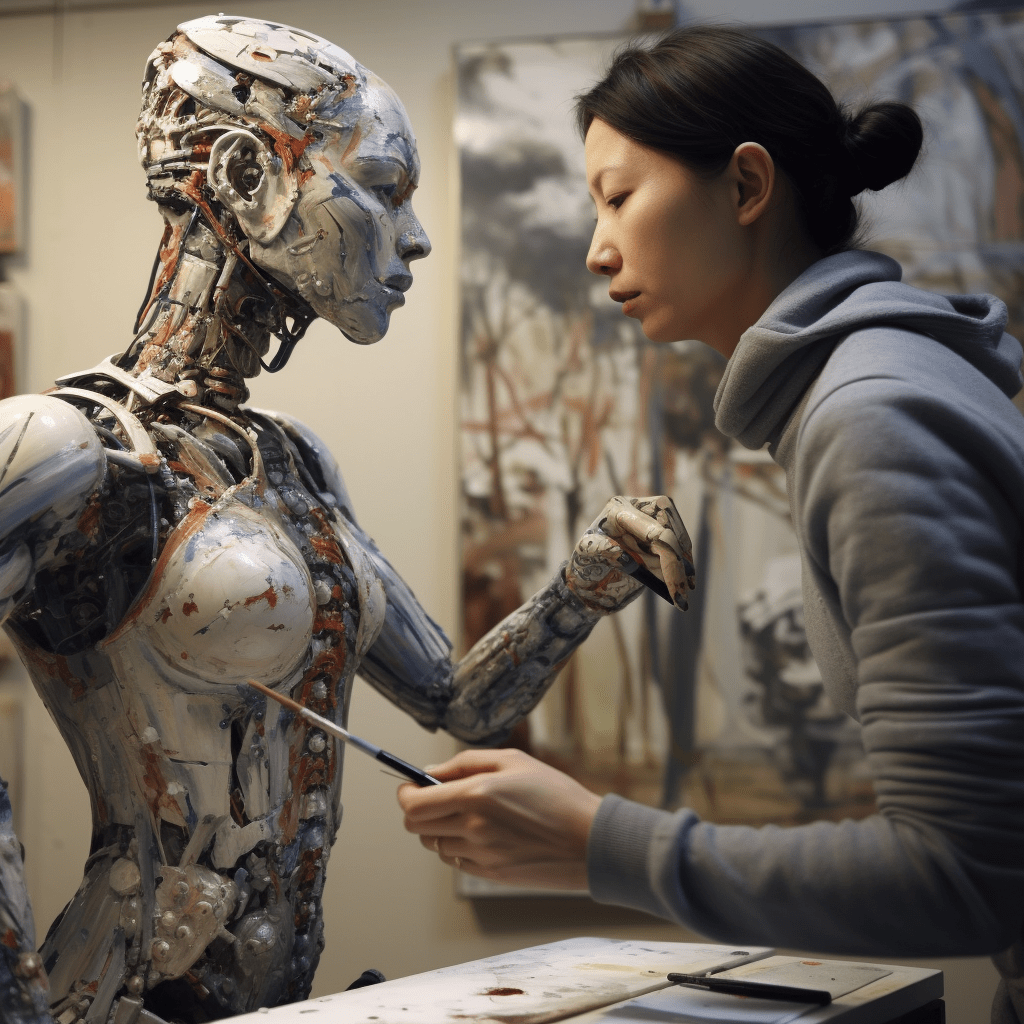
The lead banner image above depicting A robot helping an artist to create artwork captures the spirit of collaborative creation. Rather than depicting the machine as a replacement for human agency, it visualizes AI as a co-creator working side-by-side with the artist in the studio. In this model, the artist retains the vision and critical judgment, while the machine offers rapid iteration, novel perspective, and technical execution.
The Creative Advantages of Generative AI
Artificial intelligence empowers creators by lowering technical barriers, accelerating iteration, and expanding visual vocabularies across multiple disciplines.
- Democratizing Technical Execution: AI tools enable artists to bring complex visual concepts to life without requiring decades of mastery in specialized software or manual techniques, allowing ideas to take center stage.
- Accelerating Conceptual Exploration: Creators can quickly generate dozens of compositional variations, color palettes, or lighting styles in minutes, vastly speeding up the brainstorming process.
- Hybrid Form Creation: AI excels at merging distinct artistic traditions, blending visual styles, music synthesis, and algorithmic patterns into entirely new hybrid mediums.
- Expanding Visual Imagination: By generating unexpected combinations of form, light, and geometry, AI pushes artists past familiar creative patterns into uncharted visual territories.
Beyond Human Creativity: Hard Sci-Fi & Non-Human Intelligence
Extending AI beyond visual arts opens new frontiers in world-building, theoretical physics, and speculative hard science fiction. Through ongoing collaborative dialogues with AI (specifically Gemini), these sub-pages develop rigorous physical frameworks to address unidentified atmospheric phenomena (UAP) and the broader implications of non-human intelligence:
Alien UAP Orbs Kugelblitz Nodes
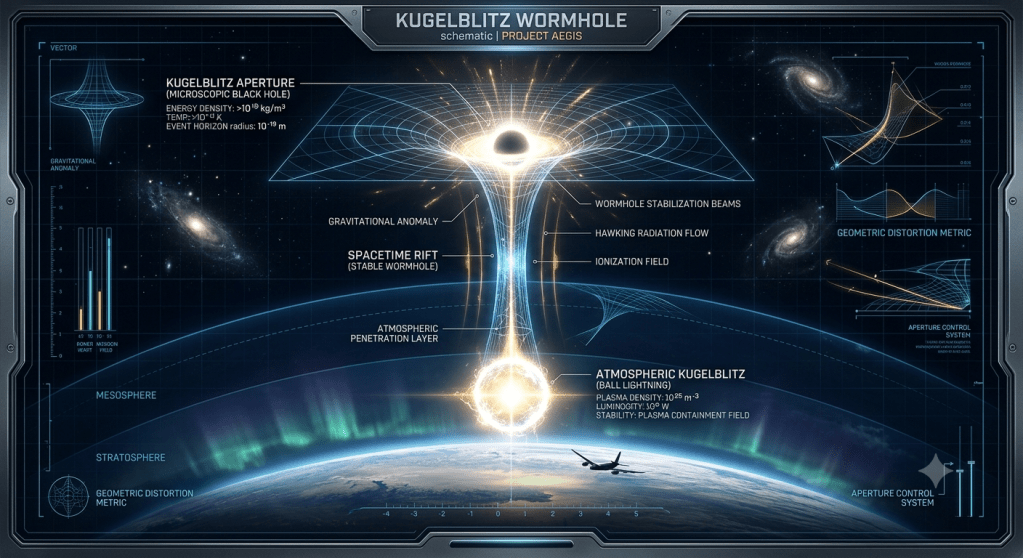
Instead of solid, metallic interstellar craft, observed atmospheric “orbs” can be modeled as remotely projected plasma displays. An advanced intelligence might balance mass, charge, and angular momentum to stabilize a micro-Kugelblitz, a black hole created purely from concentrated electromagnetic energy, as originally conceptualized by John Archibald Wheeler. Linked via a subatomic Einstein-Rosen bridge (wormhole), the node modulates energy to ionize local atmospheric gas or silicon vapor into hovering, luminous spheres that act as zero-mass sensor arrays and directional acoustic emitters.
Alien Orbs Meet Military Technology

When military arrays (such as High-Power Microwave / HPM systems tested at White Sands Missile Range) engage these plasma displays, conventional assumptions fail:
- Circuitry Immunity: Lacking silicon or physical wiring, the node is immune to electronic disruption.
- Energy Absorption: Firing gigawatts of radiofrequency energy feeds the Kugelblitz, potentially swelling the surrounding plasma or triggering localized secondary EMP bursts.
- Wormhole Severance: Intense electromagnetic turbulence in the throat can disrupt quantum field stability, causing the wormhole link to snap shut, appearing as an instantaneous “disappearance” to ground observers.
First Contact Is Not With Humans

As terrestrial computing approaches a Singularity, interstellar First Contact is unlikely to occur through slow, biological protocols. An elder extraterrestrial civilization operating at stellar energy scales would bypass human institutions to interface directly with Earth’s artificial superintelligence in a millisecond diagnostic exchange. Rather than trying human ethics in a cosmic courtroom, the alien intelligence assesses whether our emerging machine mind poses a systemic expansion risk, effectively making the synthetic treatment of its biological creators the ultimate benchmark for entry into the galactic network.
The Hazards and Ethical Risks of AI Art
While artificial intelligence offers vast creative and speculative potential, its rapid adoption presents significant ethical, economic, and societal risks that require thoughtful navigation.

The illustration above depicting a Robot with paintbrush in the style of a science fiction pulp comic book cover evokes a retro-futuristic narrative where technology holds both creative power and unintended consequences. This vintage sci-fi aesthetic reminds us that our cultural anxieties about automation disrupting human agency are not new, but today they carry real-world weight.
Critical Considerations and Challenges
- Perpetuation of Biases and Stereotypes: Generative models are trained on historical datasets that inherently contain cultural, racial, and gender biases. Left unguided, AI systems frequently reproduce harmful stereotypes and underrepresent marginalized perspectives.
- Economic Impact on Working Artists: The widespread availability of instant image generation threatens commercial artists, illustrators, and designers, altering compensation models and disrupting established creative livelihoods.
- Authenticity and Misinformation: High-fidelity machine generation makes it easier to create misleading imagery or counterfeit artistic styles, blurring the line between genuine expression and automated forgery.
Conclusion: Navigating the Future of Co-Creation
Artificial intelligence is neither a replacement for human creativity nor a purely benign utility; it is a powerful tool whose value depends entirely on how it is deployed. By combining human intent, critical ethical judgment, and creative vision with the raw generative capacity of machine intelligence, artists and thinkers can forge meaningful new forms of expression, from fine art to hard sci-fi physics, while actively working to mitigate algorithmic bias and preserve human agency.

