
Experiments in Quantum Consciousness
If you are interested in the latest scientific theories of consciousness then check out the YouTube video:
- Experimental Evidence No One Expected! Is Human Consciousness Quantum After All? by Anton Petrov (length is 23:26) released June 17, 2024.
The video talks about experimental evidence that may ‘shed light’ on Nobel laureate Roger Penrose’s Orch-OR theory. Petrov talks about a recent scientific study that might offer a future path to validating Orch-OR and references an experimental study demonstrating that microtubules can exhibit quantum effects. The results of the study are published in a paper titled:
- Ultraviolet Superradiance from Mega-Networks of Tryptophan in Biological Architectures by N. S. Babcock, G. Montes-Cabrera, K. E. Oberhofer, M. Chergui, G. L. Celardo, and P. Kurian, Publication Date: April 19, 2024. Copyright © 2024 The Authors. Published by American Chemical Society. This publication is licensed under CC-BY 4.0. Open Access
A Quantum Theory of Consciousness by Roger Penrose
Penrose’s theory, known as Orchestrated Objective Reduction (Orch-OR), suggests that consciousness arises from quantum processes that occur within microtubules inside neurons.
In his theory, Penrose and his collaborator, Stuart Hameroff, proposed that quantum superpositions and quantum computations occur within these microtubules. They theorize that when these quantum computations reach a certain level of complexity, they collapse, or “reduce,” and this reduction is associated with conscious moments. In their view, consciousness is a result of quantum processes that take place in the brain.
Penrose’s theory is primarily based on his observations of the inadequacy of classical physics and computation to fully account for the complexity and richness of consciousness. In particular, he points to Gödel’s incompleteness theorem and the halting problem in computer science as indications that our understanding of physics and computation may need to be expanded to include quantum processes to fully explain consciousness.
The Orch-OR theory proposed by Roger Penrose and Stuart Hameroff is highly controversial, and there is currently no conclusive experimental evidence supporting it. The theory postulates that consciousness arises from quantum processes within microtubules in neurons, but this idea is still largely hypothetical and has not been widely accepted within the scientific community.
Superradiant Tryptophan Mega Networks
The recent paper titled Ultraviolet Superradiance from Mega-Networks of Tryptophan in Biological Architectures explores the role of tryptophan, an aromatic amino acid with strong fluorescent response, in biological systems. The authors demonstrate that mega-networks of tryptophan can exhibit a collective optical response when excited by ultraviolet (UV) light, leading to an enhancement of the fluorescence quantum yield (QY).
The study analyzes several biological architectures containing more than 100,000 tryptophan chromophores, including centrioles and microtubules, and shows that the cooperative effects induced by UV excitation can lead to the formation of strongly superradiant states. These superradiant states result in an increase in the fluorescence QY for hierarchically organized tubulin structures, even in the presence of disorder.
The findings suggest that these tryptophan mega-networks may play a role in cellular signaling and control, offering potential new insights into the mechanisms of biological systems.
Microtubules
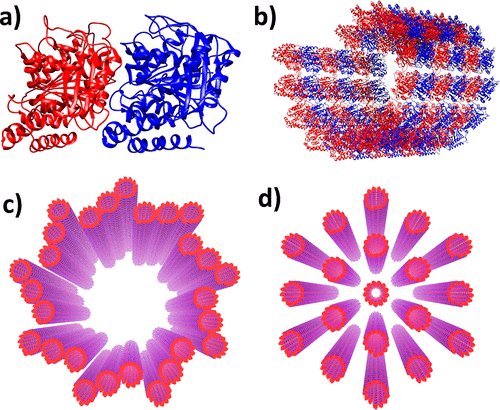
Microtubules are composed of tubulin proteins, which contain tryptophan residues. In this context, “tryptophan mega-networks” refer to the large-scale, organized structures formed by these tryptophan-containing tubulin proteins within cells and neurons, such as centrioles and microtubules. The study demonstrates that when these mega-networks are excited by UV light, they exhibit collective optical responses and superradiant states, which could have implications for cellular signaling and control.
Superradiance is Quantum Mechanical
Superradiance is a quantum mechanical phenomenon. It occurs when a group of atoms or molecules, under certain conditions, emit light or radiation in a coherent, synchronized manner, resulting in an enhanced emission rate compared to the individual emitters. In the context of this study, the tryptophan mega-networks within microtubules exhibit superradiance when excited by UV light, leading to an increase in the fluorescence quantum yield. This collective, synchronized behavior of the tryptophan residues is a quantum effect, and it could potentially play a role in cellular communication and regulation.
In the video by Petrov the implication is that the Orch-OR theory of quantum consciousness may have received its first supporting experimental evidence. That would be an incredible breakthrough in our understanding of consciousness if it turns out Penrose and Hameroff are correct. Of course this is only a single study and must be reproduced with many more studies needed.
Superradiance and LASERs
Superradiance in tryptophan mega-networks within microtubules is a phenomenon closely related to lasers. The acronym “laser” stands for “Light Amplification by Stimulated Emission of Radiation,” and it’s a prime example of superradiance in action.
In a laser, atoms or molecules are excited by an external energy source, causing them to emit photons in a synchronized and coherent manner. This synchronization of photon emissions leads to a highly focused and intense beam of light that we’re all familiar with.
Further Down the Microtubule Hole
Similarly, the superradiance observed in the tryptophan mega-networks within microtubules also involves the coherent and synchronized emission of light or radiation. However, instead of being produced by an external energy source, the superradiance in this case arises from the intrinsic organization and properties of the tryptophan residues themselves.
Our Body of Light
Given that tryptophan is an essential amino acid present in virtually all proteins, and considering that microtubules are ubiquitous structures within cells, one could indeed say that the human body is imbued with a tryptophan “mega-mega-network” of sorts.
Tryptophan residues are found in a wide variety of proteins, not just in microtubules. They play a role in protein structure and function, and they’re also involved in various metabolic pathways. Additionally, tryptophan is a precursor for the synthesis of neurotransmitters like serotonin and melatonin, which are crucial for regulating mood, sleep, and other physiological functions.
So, while the superradiance observed in the study specifically pertains to tryptophan residues in microtubules, the broader significance of tryptophan and its distribution throughout the human body cannot be overstated.
A Scientific Metaphor for Light-Body Yoga
We now have a scientific metaphor to better visualize the light-body of yogic traditions. Given a highly significant tryptophan distribution throughout the human body, and given the possibility of superradiance ubiquitously occurring within the body, we may now come to better appreciate the ancient “light-body” yogic meditations.
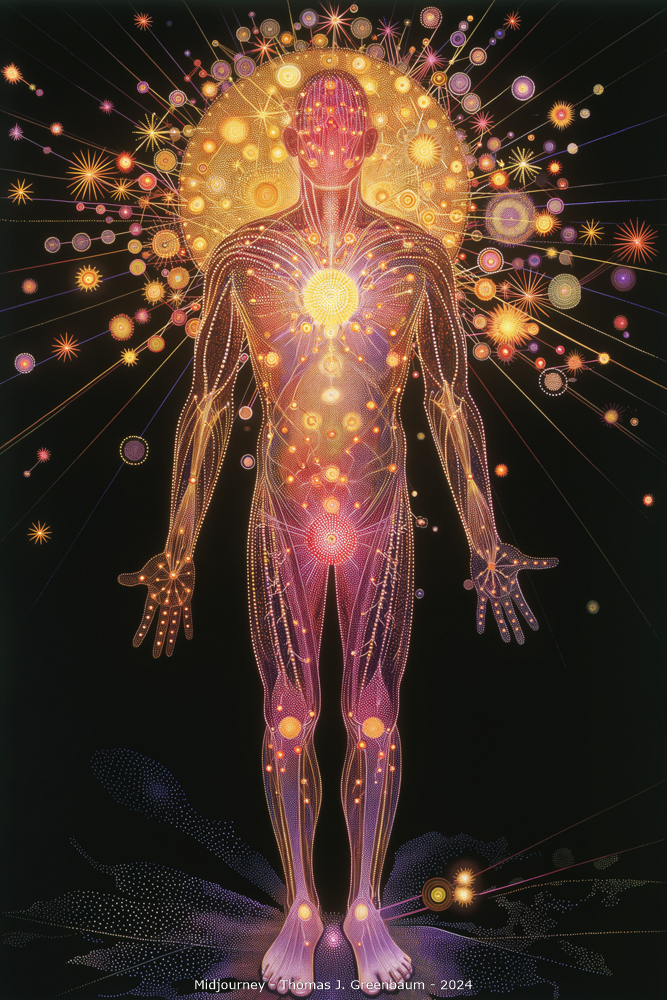
The idea of the “light-body” in yogic traditions often refers to a subtle, non-physical aspect of the self that is associated with higher states of consciousness and spiritual enlightenment. While the exact meaning and interpretation of the light-body may vary among different traditions, it’s intriguing to consider that the superradiance of tryptophan residues throughout the body might provide a physical correlate or metaphor for this concept.
Sutra 3.56 from the Yoga Sutras of Patanjali
The sutra, “kaivalyam sattva-purushayor iti” (कैवल्यं सत्त्वपुरुषयोः इति), is often translated as:
“Absolute freedom is experienced when the higher intellect becomes as pure as Awareness Itself.”
In this sutra, Patanjali is discussing the state of “kaivalya,” which refers to the ultimate goal of yoga: the state of liberation or complete freedom. According to this sutra, kaivalya is attained when the higher intellect (“sattva”) becomes as pure as Pure Awareness (“purusha”). This means that the mind must be completely free from all impurities, attachments, and distractions in order to experience true liberation and union with the divine.
“By yogic discipline, the veil of ignorance is lifted from intelligence. This is the real and true light: vivekaja jnanam, illuminative consciousness. It becomes equal to that of the light of the soul, purusa. The distinction between intelligence and consciousness comes to an end.”
Light on the Yoga Sutras of Patanjali by BKS Iyengar, sutra II.56
The term “vivekaja jnanam,” is associated with concepts such as pure awareness, vivid and true knowledge, and discriminative discernment. It is a key concept in Jnana Yoga philosophy, which focuses on the path of knowledge and understanding one’s true nature.
Given that “jnana” means knowledge or wisdom, and “viveka” refers to discrimination or discernment, “vivekaja jnanam” might be interpreted as a deep, profound understanding that arises from clear discrimination between what is real and what is illusory. It could be seen as a state of enlightenment or realization that comes from penetrating the veils of ignorance and delusion.
Conclusion
Of course, we must be careful not to conflate scientific findings with ancient spiritual beliefs too hastily. However, it’s certainly interesting to ponder how the superradiance phenomenon could potentially provide a new lens through which we can understand and appreciate these ancient practices.
 Karmatetra