A letter to Dr. Avi Loeb, Center for Astrophysics | Harvard & Smithsonian
Dear Dr. Loeb,
I am writing to share my admiration for your ongoing work and your recent leadership role heading the UAP Science Advisory Council. Your commitment to approaching unidentified atmospheric phenomena through rigorous, instrumented scientific inquiry, rather than speculation or reflexive skepticism, is a breath of fresh air. I have been following your blog with great interest, and your recent piece exploring whether UAP orbs could be an extension of ball lightning was particularly thought-provoking.
As a retired IT professional with over 35 years in engineering and tech infrastructure, as well as a lifelong fan of hard science fiction, I spend a good deal of my time exploring the intersection of advanced physics, world-building, and technological concepts. Reading your post, “Are UAP Orbs an Extension of Ball Lightning?”, and your breakdown of the Abrahamson & Dinniss silicon-vapor model sparked a creative “what if” bridging your atmospheric observations with general relativity.
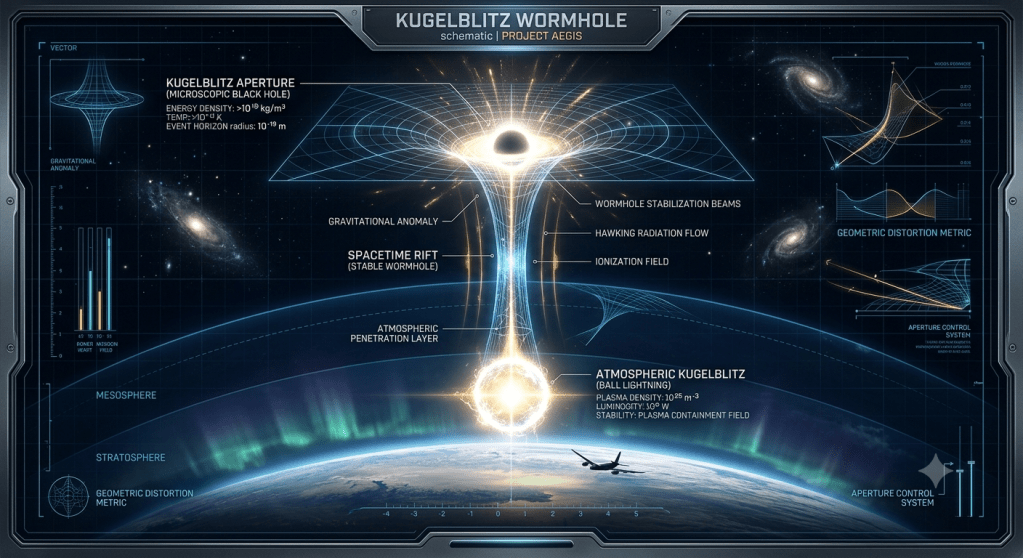
The Hard Science Fiction Thought Experiment
What if some of these prolonged, luminous orbs are not physical, solid craft traveling across interstellar space, but rather remotely projected atmospheric apertures?
Instead of moving physical mass across light-years, imagine an advanced intelligence utilizing a microscopic Kugelblitz, a black hole formed purely out of concentrated electromagnetic energy rather than mass, a theoretical solution first explored by John Archibald Wheeler in 1955. To prevent rapid Hawking evaporation, the entity maintains it at an extremal state, balancing its charge and angular momentum to stabilize the event horizon.
By anchoring one end of a microscopic Einstein-Rosen bridge (a Wheeler wormhole) directly inside the Kugelblitz, they create a functional “tin-can-and-string” connection to a distant station.
Mechanics of the Remote Node
- Plasma Generation: The remote operator modulates high-energy beams directly through the wormhole throat to ionize local atmospheric gas (or ground-derived silicon vapor, matching your 2012 Qinghai spectroscopic data), generating a self-contained, hovering plasma sphere.
- Communication & Sensing: By modulating the beam’s frequencies, the localized plasma acts as a high-precision sensor array and directional acoustic emitter, vibrating surrounding air molecules directly, much like laboratory plasma speakers, without ever needing a solid metallic chassis.
- Atmospheric Mobility: The micro-Kugelblitz itself sits at a high-altitude equilibrium or hovers along atmospheric electrical gradients, acting as the invisible gravitational anchor for the plasma display.
Explaining Classic UAP Anomalies
This framework offers an elegant, physics-based explanation for several common UAP tropes:
- Silent, Hovering Orbs: The object isn’t a metallic craft; it’s a stabilized plasma sphere continuously powered remotely through the wormhole link.
- Instantaneous Acceleration/Disappearance: Turning off or refocusing the remote beam collapses the plasma shell instantly, while the micro-Kugelblitz anchor remains virtually undetectable to the naked eye.
- Audible Hissing or Sound: Modulating the ionization rate directly vibrates the air, creating acoustic signals or directional audio.
- Passing Through Barriers: The plasma sphere can extinguish on one side of a physical barrier (like a windowpane) and re-ignite on the other as the microscopic gravitational anchor moves through unimpeded.
While your work rightly focuses on establishing empirical baseline data to identify natural atmospheric phenomena, I thought you might appreciate this speculative synthesis of plasma physics and general relativity from an avid reader.
Thank you again for your courage, vision, and dedication to pushing the boundaries of scientific inquiry. I wish you and the Advisory Council every success in this vital new chapter.
Warmest regards,
Tom Greenbaum
Retired IT Professional & Independent Researcher
(Note: Drafted with assistance from Gemini AI for research and structural refinement.)


Leave a Reply