Waking up at 4:30 AM with your mind already racing about the day ahead?
Waking up too early in the morning with a racing mind used to cause me frustration. Then I stopped fighting for more sleep and tried something else. Here is how 24 minutes of deep stillness can completely reset your workday.
Instead of tossing and turning, or reaching for your phone, there is a way to transform that unwanted wakefulness into the most restorative 24 minutes of your entire day.
Recently, after waking up earlier than planned, I decided to lean into the quiet rather than fight for more sleep. I spent 24 minutes in meditation. Read below for an explanation of why 24 minutes is recommended.
Smartwatch Technology: Health-Monitoring/Meditation App
The Meditation app on my Garmin is set for 24 minutes duration. The meditation session ends with an alert on my wrist. During the session several important health metrics are monitored. Here is what my Garmin watch tracked during the morning of October 21st at 4:46 AM:
- Average Heart Rate: 45 bpm
- Average Respiration: 12 breaths/min
- Stress Score Drop: -12 points
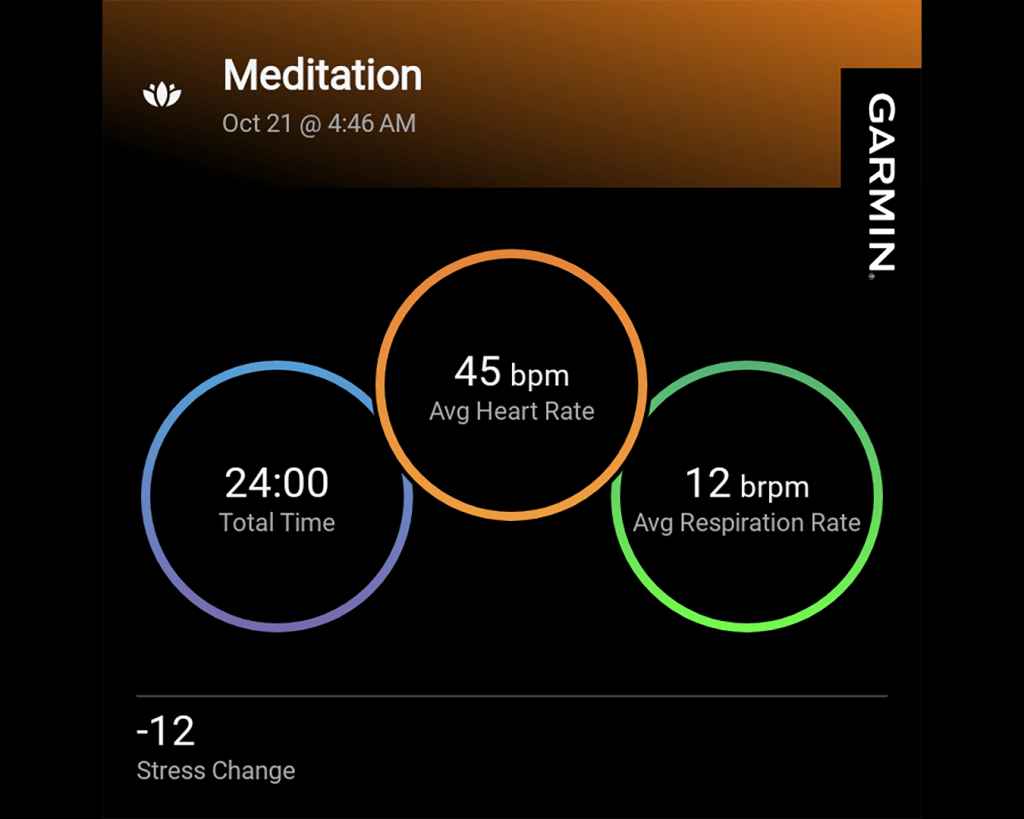
Instead of experiencing the typical early-morning spike in cortisol and heart rate caused by anxiety over daily tasks and deadlines, my body shifted deeply into the parasympathetic (“rest-and-digest”) nervous system.
Self-Reported Mental Quality: Near-total silence of internal dialogue and an almost complete absence of thought.
The Science Behind Ancient Yogic Wisdom
This isn’t just a personal observation; it’s backed by both modern neuroscience and ancient tradition:
- The Brahma Muhurta Window: In traditional yogic philosophy, the period roughly 1.5 hours before sunrise (Brahma Muhurta) is considered the optimal window for deep mental practice. Modern circadian biology explains why: our core body temperature, resting heart rate, and ambient sensory noise hit their natural low points during these hours, making deep mental stillness significantly easier to achieve.
- Physiological Parallels with Yogic Studies: Landmark research from Harvard Medical School and studies on advanced practitioners show that deep meditation induces acute cardiovascular deceleration, sharp drops in oxygen demand, and brainwave shifts into calm Alpha/Theta states. Reaching a sustained resting rate in the mid-40s while conscious demonstrates how profoundly meditation can quiet the central nervous system.
Decoding the Biometrics: What the Data Reveals
To understand why a 24-minute early-morning meditation session can be so transformative, it helps to examine the physiological markers behind the numbers:
- Average Heart Rate (45 bpm): A heart rate in the mid-40s while fully conscious reflects strong vagal tone, the activity of the vagus nerve, which acts as the body’s primary “brake” on the cardiovascular system. While typical resting heart rates range between 60–100 bpm, reaching 45 bpm demonstrates a complete disengagement of the sympathetic (“fight-or-flight”) system and a swift transition into an acute parasympathetic state.
- Average Respiration (12 breaths/min): A steady, low-effort breathing rate indicates that the autonomic nervous system has stabilized naturally. Rather than experiencing the rapid, shallow breathing triggered by waking thoughts or daily stress, the body enters an efficient rhythm with reduced metabolic oxygen demand.
- Stress Score Drop (-12 points): Measured through Heart Rate Variability (HRV), the millisecond-level variation between consecutive heartbeats, this drop signals a profound shift into physical recovery. Instead of triggering a morning spike in cortisol and blood pressure, the body reverses the stress response entirely, turning unexpected wakefulness into systemic restoration.
A Mindset Shift for Early Awakenings
For many of us when facing demanding days, early awakenings often feel like a penalty. But when you reframe early waking from a frustration into an opportunity for structured, deep rest, you accomplish two critical things:
- You eliminate the mental fatigue of trying to force sleep.
- You enter your workday clear-headed, grounded, and resilient.
A Powerful Preparation
Next time you find yourself awake before your alarm, try sitting quietly instead of worrying about lost sleep. You might find it’s the most powerful preparation for your day you could ask for.
The Significance of a 24 minute Meditation

The significance of 24 minutes in traditional Buddhist texts (frequently referenced in treatises on Shamatha, Vipashana, and foundational meditation structures utilized across Tibetan traditions including Dzogchen contexts) comes down to an ancient unit of time:
- The Ghatika or Chu Tshod: Twenty-four minutes corresponds to one ghatika (in ancient Indian timekeeping) or one chu tshod in Tibetan. This is precisely one-sixtieth of a 24-hour day (equivalent to a 24-minute hour or a traditional Indian time-unit measured by water clocks).
- A Standard Traditional Interval: In classical texts like Kamalaśīla’s Stages of Meditation (Bhavānākrama)—which heavily influenced Tibetan contemplative training—24 minutes is often cited as an ideal initial duration for a formal sitting session.
- The Sweet Spot for Stability: Teachers often recommend this duration because it is long enough for the gross layers of daily distraction and mental turbulence to settle down, yet short enough to prevent the mind from collapsing into dullness (sthena) or the body from becoming excessively restless or cramped when first building a stable habit.
As masters often note, rather than straining through massive, unbroken hours right away, breaking practice down into fresh, highly focused 24-minute intervals (or repeating them with breaks in between) helps train the mind to remain clear and undistracted without burning out.
#Meditation #Mindfulness #Performance #Wellness #Leadership #Parasympathetic #Health #Restorative #Practice


Leave a Reply